



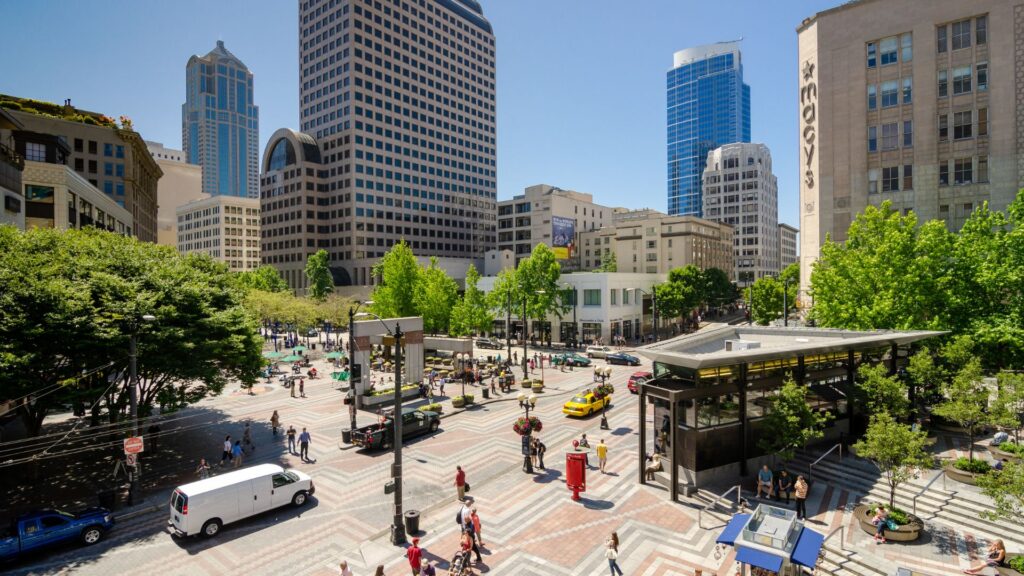
A new report from the Downtown Seattle Association is drawing attention to the city’s struggling office market. Released June 15, the analysis says downtown Seattle has lost roughly 30,000 jobs and more than $10 billion in office value since 2020. The report links the losses to a series of business taxes, most notably the city’s payroll tax, often called the JumpStart tax, which the Seattle City Council passed that same year.
The report, titled “The Tale of Two Cities,” compares Seattle’s economic trajectory with that of neighboring Bellevue. According to the DSA, downtown Seattle’s office vacancy rate climbed from 6% in 2019 to 32% in 2025. Bellevue’s commercial core, by contrast, has stayed comparatively steady over the same period. The organization frames the divide as evidence that Seattle’s tax structure is reshaping where businesses choose to grow.
The JumpStart tax was created with different goals in mind. Backers said it would support housing programs, aid small businesses, and help fund the city’s climate goals. Five years later, the DSA argues the tax and related policies have produced the opposite effect downtown. The details of how the tax works and who it actually applies to explain much of the disagreement.
The Tax Targets Seattle’s Highest-Paying Employers
The JumpStart Payroll Expense Tax originally applied to payrolls of $7 million or more. It now applies to companies with payroll expenses exceeding roughly $9 million annually that also employ at least one employee earning $194,452 or above. In 2026, the report estimates the tax cost affected businesses between $1,450 and $9,390 per job, a cost aimed squarely at the city’s largest, highest-paying employers.
The contrast between the two cities shows up clearly in property data. Seattle’s office properties dropped 48% in value between 2020 and 2025, the DSA reports, while Bellevue’s climbed 7% over that same period, a divide the DSA attributes largely to differences in each city’s tax policies. Vacancy shows the same gap: Seattle sits at 32% downtown, compared to 24% in Bellevue.
Beyond the payroll tax, the DSA points to Seattle’s broader business tax structure as a factor. Depending on the industry, Seattle businesses can pay two to four times more in business and occupation tax than their Bellevue counterparts. Seattle also imposes a 5% social housing tax on high compensation, along with a higher minimum wage and property tax rate than its neighbor, adding to the cost of operating downtown.
City Officials Are Pushing Back on the Findings
Jon Scholes, president and CEO of the Downtown Seattle Association, said the findings reflect a deliberate look at the tax’s impact. “We’ve lost 30,000 jobs. We’re going in the wrong direction,” Scholes said. He added that the organization wanted to examine what the taxes have actually meant for job growth in Seattle since they took effect, rather than rely on projections made in 2020.
Not everyone agrees with the DSA’s framing. Former Seattle City Councilmember Teresa Mosqueda, who helped author the JumpStart tax, called the report’s interpretation “very misinformed and clearly an attempt to rewrite history.” Mosqueda said the tax kept Seattle “in the black” and allowed the city to avoid deep budget cuts after the pandemic. She also said Seattle has outpaced other large cities in building affordable housing.
Seattle Mayor Katie Wilson also defended the tax in a statement to Fox News Digital, calling it a key reason the city bounced back from the pandemic’s worst economic effects. She said collections from the city’s largest companies have outpaced the city’s early estimates. Wilson pointed to that growth as proof the tax has strengthened, not weakened, the local economy.
Seattle’s Revenue Outlook Could Keep the Debate Going
The financial picture ahead may add fuel to the debate. Seattle’s Office of Economic and Revenue Forecast projects the city will collect $385.1 million from the tax in 2026, a 7.6% drop from 2025. If that estimate holds, it would mark the first year of declining collections since the tax took effect, raising questions about how reliable the revenue stream will remain going forward.
City forecasters have also flagged a slower labor market ahead, telling council members in April that the region’s job market is underperforming the nation’s, with no net job growth expected locally before late 2027. That timeline complicates any quick resolution to the disagreement over whether the tax, broader economic conditions, or shifts in office demand since the pandemic are driving the job losses downtown.
The DSA’s report closes with a call to action rather than a forecast, pushing the city to cut business costs, move faster on development permits and bring more consistency to its tax and regulatory rules. Whether city leaders adopt that approach remains an open question. For now, the report adds another data point to an ongoing argument between business groups and city officials over what is actually driving downtown Seattle’s economic changes.
